
The Voice Problem and the Architecture of Revision
From Adjective-Driven Prompts to Blended Profiles and the Revision Loop

There’s a lie buried in most AI writing advice, and it’s doing a lot of damage. The lie is that the hard part is getting words on the page. It isn’t. Any generic model can produce fluent prose on demand: smooth, confident, readable prose that sounds like a very competent graduate student summarizing your ideas back to you. That is not useful. A fluent summary of your thinking is not an extension of your thinking. Fluency is not argument, and long is not enough.
The hard part is making the machine carry the specific, idiosyncratic weight of how you think on the page. And you cannot do that with a style prompt. “Write in a direct, slightly contrarian academic voice” will get you something passable and useless. The patterns that make your writing yours (how you build toward a claim the reader will resist, when you pull back and acknowledge a real limitation, or the register you shift into at the end of a section) cannot be described by adjectives. They have to be extracted.
So I extracted them. Before writing a single page of the book, I read a decade of my own published work with the detachment of an editor and the precision of a coder. Not for content. For pattern. How do I open a section when I’m about to say something the reader will push back on? How do I use humor to create permission for an uncomfortable claim? What does my prose look like at the top of a chapter versus the bottom? I isolated twenty distinct authorial profiles. Each one has a structured description and a short example document that demonstrates it in practice.
When any AI in my workflow generates prose, it blends two profiles simultaneously. The blending prevents what you can usually feel from fifty feet away in AI writing: the monotonous regularity of a single register, sustained for pages, like someone reading a legal brief in an even tone. Two blended voices create enough internal variation to hold a reader. The output doesn’t sound like me yet. But it sounds like something I was on the way to writing, which is what I need to have a real argument with.

That extraction work is the investment most people skip. It is not glamorous. It cannot be rushed. It required reading my own writing with a kind of analytical distance I don’t usually have access to, making explicit patterns I had never consciously noticed, and encoding them precisely enough for a machine to follow. Anyone who claims they built a voice-aligned AI workflow in an afternoon has not actually done it. But this is also the investment that makes everything downstream possible, because it means the AI is working from a model of how I think, not a generic model of how academics write.
Once the voice profiles existed, the drafting could begin. And this is where the process gets counterintuitive.
For each chapter, the AI produced a first draft at roughly half the target length. Not a polished half — a structural half. An argument skeleton with connective tissue. A hypothesis about what the chapter could be.
Then I stopped.
I read the draft carefully, treating it as a proposal rather than a product. I surfaced relevant passages from the knowledge graph, which often pulled in material I hadn’t consciously planned to include. And I looked for where the AI had lost the thread. It always had, somewhere.
The AI does not hedge when it goes wrong. It produces confident, plausible-sounding conclusions in exactly the same register as accurate ones. The only way to catch the drift is to know your argument well enough to feel when something has slipped. In one chapter, the AI was framing an epistemological argument in terms of organizational behavior. The drift was subtle enough that a reader unfamiliar with the material might have let it pass. I caught it because it was my argument, and correcting it forced me to articulate the distinction more precisely than I had in the outline. The machine’s error sharpened the chapter.
Give the AI a direction. Let it lose that direction in a specific way. Recover it. Every time you complete that cycle, you understand your own argument more precisely than you did before. Treat every significant AI error as a diagnostic. The mistake doesn’t matter. What it reveals about your argument does.
In every previous book project, structural gaps only became visible once the whole manuscript was on the table, a late-stage discovery that meant expensive, retrospective repair. With a knowledge graph that already holds the shape of your thinking, you start from a sense of the assembled whole and work backwards into each chapter. The gaps are visible from day one. Revision is not a phase that comes later. It is woven into how every draft is produced.
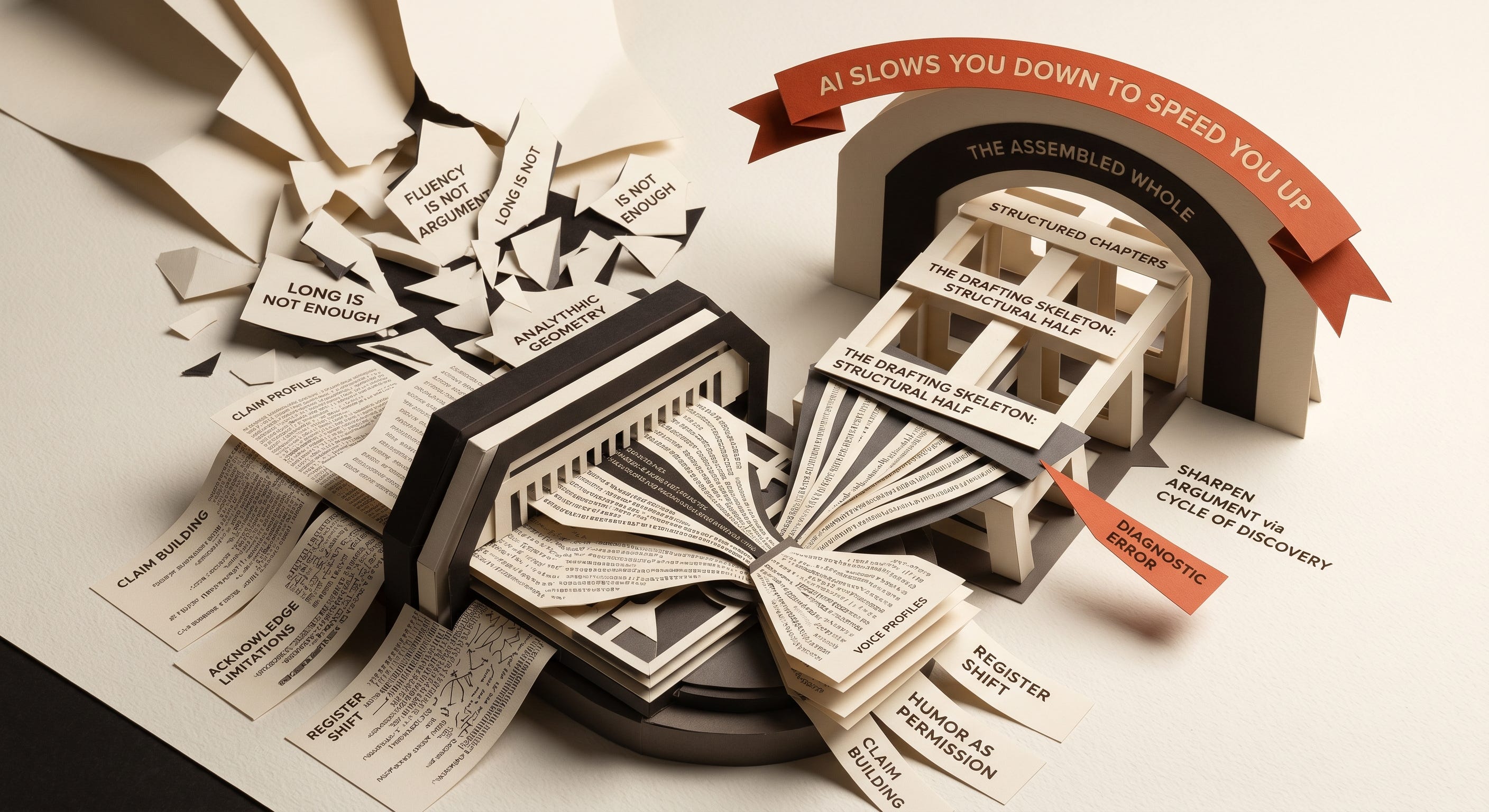
AI used at its best slows you down before it speeds you up. It forces you to articulate what you believe before you ask the machine to help you say it. It surfaces structural failures at the draft stage, where they cost an afternoon, rather than the proof stage, where they cost a month. The speed that everyone notices (the timeline that didn’t make sense to Patrick) is downstream of this discipline, not a substitute for it.
The machine handles the structural labor of holding a long draft together. You focus on whether the argument is actually true. Those are separable tasks, and separating them makes both easier. Stop trying to do them at the same time.